Showing posts with label benefits of patent in india. Show all posts

Wednesday, 28 October 2020

A careful dissection of the Madrid System


It is appropriately established that the Madrid System is bifurcated into the Madrid Agreement (1891) and the Madrid Protocol (1989). It was a welcoming introduction in the realm of trademarks for it sought to marshal and leave tangle-free the filing of trademarks abroad, which was regarded as being quintessential since trademark laws in all jurisdictions vary in practice. The system, alongside the many added benefits, enables a streamlined filing procedure with a modest fee, decreasing the quantum of applications to be filed for a single mark.

To give a brief overview, availing the benefits entailed in the Madrid System requires an applicant to file a national trademark application, also known as the ‘Basic application.’ The proprietor is then eligible to file a request for International Registration (IR) of marks, which is a means of progressing and increasing the outreach of the application to the designated states.
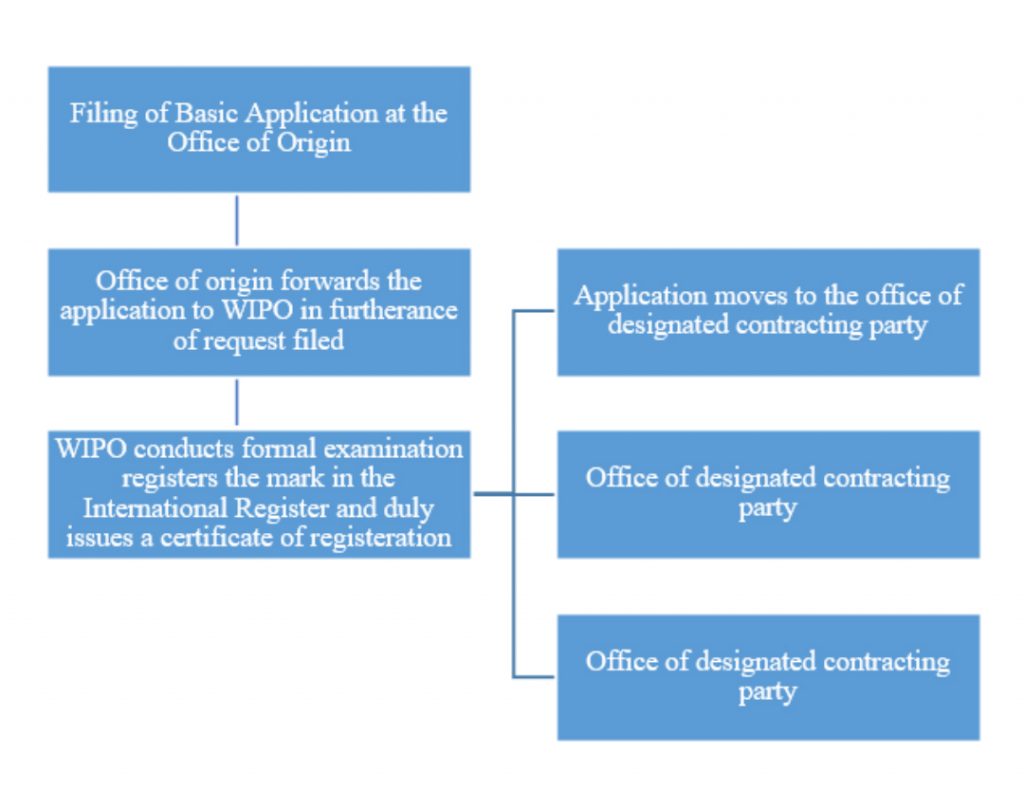
Process of Filing

Fig1: Process of Filing

Although the two contribute to the creation of the Madrid system, per se, there are differences found within the two bifurcations since the Protocol aimed at overcoming the problems within the Agreement. Therefore, the key features of the Protocol can be contrasted with the Agreement as per the points of differences mentioned below:

  • Primarily, as per the Madrid Protocol, a ‘Basic application’ would also suffice for the filing of an IR contrary to just the basic registration.
  • Also, where the Agreement requisitioned French as the only official language, the Protocol added English and Spanish to the list of workable languages.
  • Furthermore, the Protocol limits the period for notification of refusal of the IR to a period of 12 months to 18 months, where the Agreement resorted to a twelve-month window period. The Protocol enables a prompt establishment and centralized manner of controlling rights emanating out of registration.
  • Lastly, the scope of protection of marks is 20 years as per the Agreement, whereas the Protocol limits it to 10 years, which is further subject to renewal in both cases.

It might appear trivial to pluck out any blemishes in the system after 31 years of successful enforcement; however, it seems to be pertinent to uncover the positives as well as the negatives before actually resorting to either of the two routes for seeking protection of marks.

The gravest issues arising under the Madrid System is the issue of ‘central attack,’ which contemplates the fact that since the foundation of the application is based on one national application, in the event of cancellation or abandonment or proven invalidation, the same would naturally result in the automatic cancellation of all ancillary protections sought through the System. The situation can indeed be recovered from since the Madrid Protocol facilitates a procedure for conversion of International Registrations (IRs) into national applications for each of the designated states within three consequent months after paying due consideration. Contrary to the Madrid Protocol, the Madrid Agreement provides no such remedy. However, this hurdle has a fixed tenure of 05 years after which any harm to the basic application would not affect rights protected abroad since, after the lapse of the five-year period, IRs become independent of the national registration.

Furthermore, international registrations follow a strict timeline of processing, which is eighteen months. Quite often, the applications at the national phase are not processed by then, frequently leading to untimely objections and concerns, which could economically be very damaging for the proprietor of the concerning trademark.

Another added disadvantage here is that where on the one hand, it is popularly acclaimed that intellectual property rights are easily transferable – the Madrid System, on the other hand, limits this right only to the convention countries. Thereby, once the Madrid route is taken, assignment or transfer of rights beyond convention countries is not permissible; the proprietor then has to convert the mark into a local mark, which is not only heavy on the pocket but also a complex procedure. Thus, this could be disadvantageous where a potential opportunity from non-Madrid abiding countries is encountered for probable profitable sales or assignment of rights. Also, a handful of the countries do not acknowledge registration certificates issued under the aegis of WIPO, which ultimately implies resorting to the aid of national trademark offices for a recognized certificate at an additional cost.

In addition to this lies the problem of making modifications to the classification in the Madrid-based application. It is permissible to wipe-out, but making additions to the classification to broaden the admissibility of the said application, is not permissible. Any material or non-material changes to the mark are also not warranted.
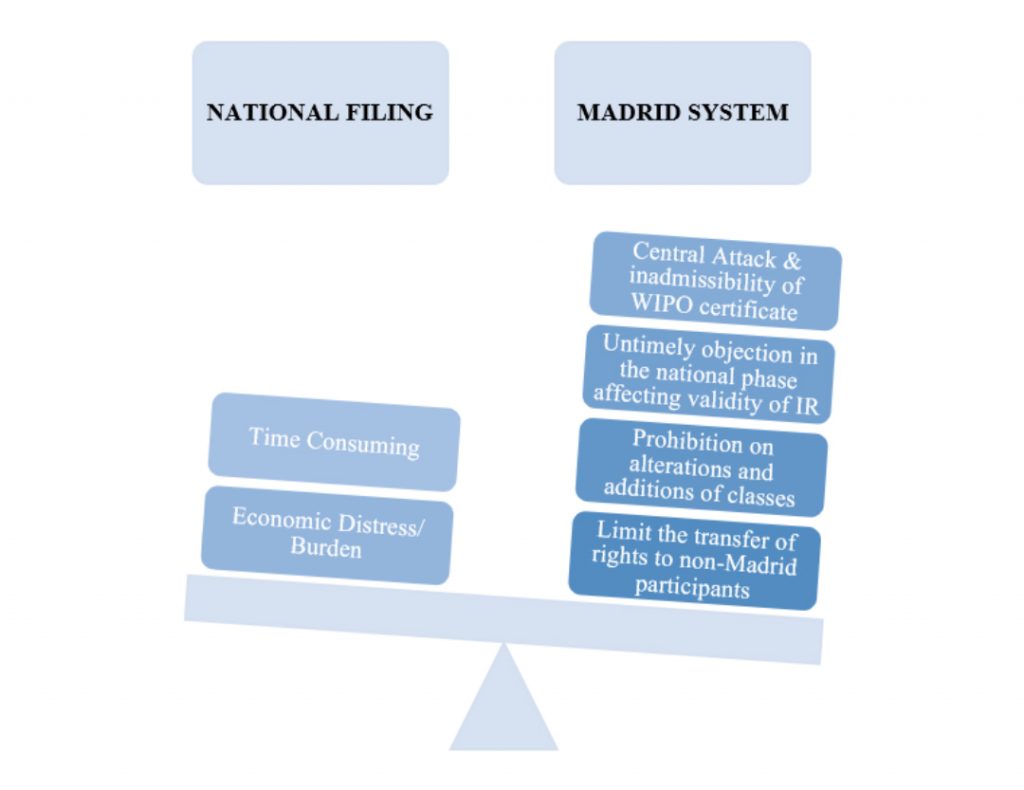
Scale of disadvantages

Fig.2: Scale of disadvantages

Although it may be appealing to blindly resort to the Madrid Protocol as it offers to be a ‘one-stop-shop’ for one’s effort to trademark coupled with the benefit of a simple yet speedy examination (as acclaimed) and a cost-effective approach by delineating the need of a local council, it is imperative to take into consideration the limitations mentioned above. Hence, it is highly advisable to conduct a cost-benefit analysis of the number of jurisdictions along with the practices opted therein since all jurisdictions are not tenable to the Protocol. Also, comprehensive searches in designated jurisdictions need to be conducted to uncover prior marks, which otherwise could prove harmful in the aftermath. A concrete branding strategy ought to be put in place to avail of the maximum potential value of the trademark at hand. 👉   For view source:  https://bit.ly/34A4B4E


Don’t forget to follow us on social media:

Facebook – https://www.facebook.com/kashishipr/

Twitter – https://twitter.com/kashishipr

Linkedin – https://www.linkedin.com/company/kashishipr/

Pinterest – https://www.pinterest.com/kashishipr/

Tumblr – https://kashishipr.tumblr.com/


Contact - US

Email Id: kashishipr@kashishipr.com

Website: www.kashishipr.com

Tuesday, 25 August 2020

Priority Watch List Strikes Again


The Special 301 report prepared yearly by the United States Trade Representative (USTR) includes the Priority watch list countries identified as having several serious Intellectual Property Rights inadequacies that need increased USTR surveillance. India once again becomes a victim of this outrageous list for the 27th year in a row due to its insufficient measurable improvements on the Intellectual Property Rights framework that have long-lasting impacts and challenges leading to negatively affecting the American right holders. Although India has taken several steps to discuss the problems of the protection and enforcement of the IP rights, many of the actions have not yet converted into tangible advantages for the creators, due to which India, according to the latest Special 301 report, still prevails as one of the world’s most challenging economies with respect to management of IP rights.

It is a matter of fact that, yes, India has definitely dismissed the observations in the Special 301 report over the years admitting it as a unilateral report of the US since India was completely amenable with multi lateral IP directives.

Along with India, USTR has identified 11 countries in its Priority Watch List including China, Indonesia, Russia, to name a few. In the report, the US mentioned that India has major long-standing IP issues making it arduous for creators to receive and perpetuate patents in their respective businesses, particularly for pharmaceuticals. Besides these long-standing concerns, India furthermore confined the transparency of information on state-issued pharmaceutical manufacturing licenses.

Moreover, India failed to create a productive system for protection against the inequitable commercial use and the unsanctioned disclosure of data produced to acquire marketing approval for various chemical products used in agriculture. The report even asserts that both China and India were the leading origins of the spurious medicines distributed on a broad scale. “Though the exact figure is not disclosed, studies have suggested that up to 20% of the drugs sold in the Indian markets could pose a serious threat to human life.”

In spite of India’s repeated premises of restraining IP laws to increase access to the growing trend in technologies, the USTR declared that India maintained exceptionally high custom duties towards IP intensive products such as pharmaceuticals, medical devices, solar energy equipment, etc.

At the same time, the report also pens down some of the best practices by India in the IP sector last year. India’s Cell for Intellectual Property Rights Promotion and Management (CIPAM) assembles the government’s efforts to unravel processes, encourage commercialization, and increase IP awareness.

As a result of the deterrent given to India and other countries, the USTR wants the governments to support the predictability of IP systems by making sure to use obligatory licenses only when the circumstances are extremely unlikely and after putting in all the efforts required to procure authorization from the patent owner using rational terms and conditions.

According to the report, The US will continue to look at developments as required with the trading partners including India. 👉 ✅  For view source: https://bit.ly/3ljauJy

Don’t forget to follow us on social media:

Facebook – https://www.facebook.com/kashishipr/

Twitter – https://twitter.com/kashishipr

Linkedin – https://www.linkedin.com/company/kashishipr/

Pinterest – https://www.pinterest.com/kashishipr/

Tumblr – https://kashishipr.tumblr.com/

Friday, 14 August 2020

US Court Orders Apple to Pay $500 Million Over PanOptis 4G Patent Violations


A Texas court has quite recently ordered the American multinational technology company, Apple Inc., to pay even more than $500 million, near about Rs. 3, 742 crores, in damages and interest for 4G Patent Violationsheld by Intellectual Property (IP) Company PanOptis.

According to the local media, the US tech giant – now worth almost $2 trillion (roughly Rs. 1, 49, 70,000 crores) has vowed to appeal this decision.

In an email response, Apple thanked the jury for their time and also expressed how disappointed it is with the court’s verdict. The company said that it has plans to appeal the court’s decision. The tech giant believes that lawsuits like the one in question by companies who accumulate patents to harass the industry serve only to harm the customers and stifle innovation in general.

PanOptis, a company specializing in licensing patents, took Apple to court in February 2019 by claiming that the US tech giant refused to pay for the use of 4G LTE technologies in its watches, tablets, and smartphones. According to the court filing, PanOptis did make a lot of effort repeatedly to reach an agreement with Apple for a FRAND license over its infringed upon Patent Portfolios. FRAND is an acronym for fair, reasonable, and non-discriminatory terms and refers to the IT industry standard for technology use. PanOptis said that the negotiations proved to be unsuccessful as Apple refused to pay a FRAND royalty to its patent license. Apple, on the contrary, said that the patents were invalid according to the legal publications.

This case is one of the many Patent Infringement lawsuits filed by the licensing companies that make no products of their own but do hold the rights to several technologies.

In the past, the Texas court has ruled twice against Apple by demanding it to pay hundreds of millions of dollars to VirnetX, which is another company specializing in Patent Litigation.

On its official website, PanOptis offers services corresponding to managing its clients’ patents by allowing them to concentrate well on new development and innovation. For view source: https://www.kashishipr.com/blog/us-court-orders-apple-to-pay-500-million-over-panoptis-4g-patent-violations/


Don’t forget to follow us on social media:

Facebook – https://www.facebook.com/kashishipr/

Twitter – https://twitter.com/kashishipr

Linkedin – https://www.linkedin.com/company/kashishipr/

Pinterest – https://www.pinterest.com/kashishipr/

Tumblr – https://kashishipr.tumblr.com/


Contact - US

Email Id: kashishipr@kashishipr.com

Website: www.kashishipr.com

Wednesday, 29 July 2020

Understanding the Critical Elements of a Cost-Effective Legal Department


intellectual property protection

Without any second thoughts, controlling the costs in a legal department can, at times, prove to be exceedingly challenging, specifically when it comes to a growing business. Although it is imperative to protect and maintain the legal rights of businesses adequately, it is equally imperative to ensure that the legal and business strategies are well-aligned so that the legal services can effectively manage the Intellectual Property (IP) portfolio. So, let us now make ourselves familiar with a few aspects, using which a legal department can minimize its cost, that too, with little optimization.
1.     IP Benchmarking
As a brand or a business grows, there may be a coinciding growth of the IP portfolio as well. The same can prove to a bit challenging for the legal departments in business companies or organizations as every new IP asset comes with a set of additional costs. In this scenario, the concept of IP benchmarking can help the legal departments in controlling the costs of Intellectual Property Protection within the IP portfolio. With effective IP benchmarking, the legal team shall be able to understand the value and influence of every other IP asset not only individually but also as a part of the overall IP portfolio. Furthermore, the IP benchmarking process can offer valuable insights into the costs of IP protection in the market by comparing the service providers and seeing what the competitors are paying for the same set of services. It will help in making sure that a business company or organization doesn’t overpay for external legal services or fees.
2.     Resource Allocation
If the legal department of a company operates within a growing business, then it sometimes becomes difficult to control the costs as there may be a need to hire new staff members for supporting the legal work associated with the business growth. It can also include the requirement for having a specialized legal counsel. For the same reason, the legal department and the general counsel should together evaluate how the different staff members are allocated among different cases, both by time and skillset. Also, in the scenario where there is a need for specialized legal knowledge, it can be beneficial to consult an external legal services provider. As per various recent reports and surveys conducted, the tools and techniques used by the legal departments hold immense potential for cost savings. The overall costs of maintaining these resources can increase as the legal department grows; so, it is essential to assess these resources and understand whether they provide a suitable ROI for the business or not.
3.     Outsourcing Specialized Tasks
After understanding the allocation of the internal resources, you can have a better insight into the skillset and resources, which are more cost-effective to outsource. Irrespective of whether your team is managing a high workload or you require the assistance of a specialized team for a short term project, outsourcing legal work and tasks can prove to be beneficial for many reasons. The prime advantage is that your legal team would have access to additional resources and specialists with no obligation of hiring permanent staff members or paying the high costs for legal tools. If your business owns a growing IP portfolio, then you can consult an IP specialist and enable access to a broad network of legal resources, which can lead to better IP protection, specifically when it comes to tasks like IP docketing or performing a Trademark Search. The overall benefits of outsourcing can differ from one business to another; so, it is highly advisable to seek advice from different service providers and then determine what is more cost-effective for your legal department. 


Don’t forget to follow us on social media:


Contact - US

Monday, 27 July 2020

IBM Files Second Lawsuit against Zillow Alleging Patent Infringement

patent infringement

The American multinational technology company, IBM (International Business Machines Corporation), has quite recently escalated its legal battle by filing a second lawsuit against Zillow (an American online real estate database company) alleging Patent Infringement. According to IBM, Zillow has infringed upon its patents to build a real estate search engine.
In the lawsuit filed on 21st July 2020 in federal court in Washington, IBM claimed that Zillow has infringed upon five of its patents, which improve the searches by ranking results and simplifying the content displays, among several other things. IBM also alleged that despite the written notifications, Zillow has engaged in a policy of willful blindness and is still very much using the technology. As per IBM’s statement in its complaint, dozens of similar companies, including Apple, Amazon, Facebook, and Google, have agreed to come into license agreements with IBM; however, Zillow is not among them. IBM stated that Zillow, instead, has chosen to infringe upon the five patents mentioned in the lawsuit filed without even paying due attention to having adequate licensing discussions in place.
For several years now, IBM and Zillow have been fighting over patent licensing deals.
Last year in September, IBM sued Zillow in federal court in California by accusing it of building its portal with the unauthorized use of IBM’s seven patented technologies. In that complaint, IBM stated that it had tried hard for three years to enter a licensing agreement with Zillow but wasn’t able to do the same. In that particular case, IBM is now seeking royalties on the billions of dollars in revenue, which Zillow has reportedly earned based on its infringement of IBM’s patented technology.
As per various reports and surveys conducted, IBM invests even more than $5 billion in research and development every year. The company has a history of filing patent infringement lawsuits against other tech giants like Twitter and Groupon. In March, this year, IBM filed a patent infringement lawsuit against Airbnb by accusing the travel startup of using its patents corresponding to improved navigation with advertising and bookmarks in an interactive service.
In a recent statement delivered, Zillow mentioned that it is very much aware of the lawsuit filed against it by IBM. Zillow believes that the claims in the lawsuit filed are without any merit. It further said that it would safeguard itself vigorously from this patent infringement lawsuit. For view source: https://www.kashishipr.com/blog/ibm-files-second-lawsuit-against-zillow-alleging-patent-infringement/
Don’t forget to follow us on social media:


Contact - US

Wednesday, 22 July 2020

Twitter Disables Trump's Retweet over Copyright Claim by Linkin Park


copyright violation

The widely known social networking platform, Twitter, has quite recently disabled a campaign-style video retweeted by President Donald Trump on 18th July 2020 over Copyright Violation. The video, which had music from Linkin Park (American rock band from Agoura Hills, California), disappeared from President Trump’s Twitter feed on 18th July 2020 with the notification – “This media has been disabled in response to a complaint filed by the Copyright Owner.”
Trump had retweeted the video from the social media director at White House, Dan Scavino. Twitter deleted the video after Machine Shop Entertainment had sent it a notice corresponding to the Digital Millennium Copyright Act. The notice was posted on the Lumen Database, which gets the requests for the removal of online material. According to Linkin Park’s LinkedIn profile, Machine Shop Entertainment is a management company owned by the rock band.
A Twitter representative said in an email statement that the platform responds well to all the copyright claims, which it receives from the copyright owners or their representatives. The White House, on the other hand, hasn’t yet responded to the request for comment.
This year in May, Twitter began challenging Trump’s tweets and has been clashing with him repeatedly since then. The social networking service has multiple times disabled or commented on the tweets by President Trump over violations of a policy against threatening violence and copyright complaints.
On 30th June 2020, Twitter also deleted an image tweeted by President Trump, which included a picture of himself, because of a complaint filed by The New York Times’ photographer, who had shot the image. It also disabled a tweet from President Trump behind a warning label at the end of May. According to Twitter, the tweet violated the rules against ‘glorifying violence’ when President Trump advocated that the Minneapolis authorities should have been tough in responding to the protests over the death of George Floyd. For view source: https://www.kashishipr.com/blog/twitter-disables-trumps-retweet-over-copyright-claim-by-linkin-park/

Don’t forget to follow us on social media:


Contact - US

Monday, 20 July 2020

Madras High Court Restrains Patanjali from Using the ‘Coronil’ Trademark


trademark renewals

The controversial drug, Coronil (claimed as a cure for COVID-19), by yoga guru Ramdev’s Patanjali Ayurved Ltd, has quite recently received a blow, with the Madras High Court restraining the company from using the ‘Coronil’ trademark.
Justice CV Karthikeyan has passed the interim order valid till 30th July 2020 on the plea of Arudra Engineering Private Limited, a Chennai-based company claiming that it owns the ‘Coronil’ trademark since 1993. According to the company, which specializes in manufacturing chemicals and sanitizers for cleaning containment units and heavy pieces of machinery, it got the ‘Coronil-213 SPL’ and ‘Coronil-92B’ trademarks registered in 1993 and has been diligently filing all the Trademark Renewals since then. The company stated that its Trademark Rights are valid until 2027. While claiming that its products with the Registered Trademark own a global presence, the company mentioned that its clients include Indian Oil and BHEL. For substantiating its claim, the company also presented the sales bills of its products in the last five years.
The company said that the mark adopted by Patanjali for selling the drugs is identical to its registered trademarks in all aspects. The company further stated that although the products sold by Patanjali are different; however, the use of identical trademarks would still infringe upon its Intellectual Property Rights (IPRs). According to the company, permitting Patanjali to continue using the mark shall have a direct effect on its goodwill and reputation created over its registered trademark for even more than 26 years in both domestic and international markets.
After Patanjali came up with ‘Coronil,’ the Union AYUSH Ministry (the Ministry of Ayurveda, Yoga & Naturopathy, Unani, Siddha, and Homoeopathy, abbreviated as AYUSH) had, on 1st July 2020, said that the company would be allowed to sell the drug only as an immunity booster and not as a cure for COVID-19.
Ramdev, on the other hand, had reacted to the criticism received on the efficacy of ‘Coronil,’ by saying that some people were hurt by the rise of indigenous medicine. For view source: https://www.kashishipr.com/blog/madras-high-court-restrains-patanjali-from-using-the-coronil-trademark/

Don’t forget to follow us on social media:


Contact - US