Showing posts with label Kashishipr. Show all posts

Wednesday, 28 October 2020

A careful dissection of the Madrid System


It is appropriately established that the Madrid System is bifurcated into the Madrid Agreement (1891) and the Madrid Protocol (1989). It was a welcoming introduction in the realm of trademarks for it sought to marshal and leave tangle-free the filing of trademarks abroad, which was regarded as being quintessential since trademark laws in all jurisdictions vary in practice. The system, alongside the many added benefits, enables a streamlined filing procedure with a modest fee, decreasing the quantum of applications to be filed for a single mark.

To give a brief overview, availing the benefits entailed in the Madrid System requires an applicant to file a national trademark application, also known as the ‘Basic application.’ The proprietor is then eligible to file a request for International Registration (IR) of marks, which is a means of progressing and increasing the outreach of the application to the designated states.
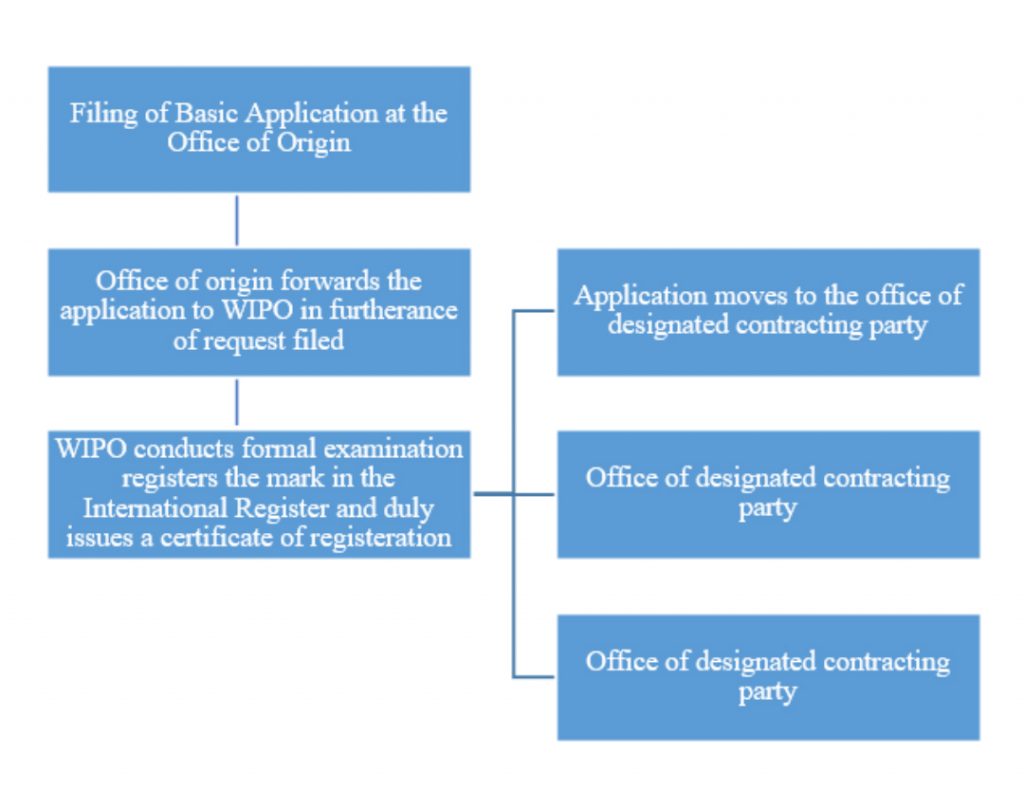
Process of Filing

Fig1: Process of Filing

Although the two contribute to the creation of the Madrid system, per se, there are differences found within the two bifurcations since the Protocol aimed at overcoming the problems within the Agreement. Therefore, the key features of the Protocol can be contrasted with the Agreement as per the points of differences mentioned below:

  • Primarily, as per the Madrid Protocol, a ‘Basic application’ would also suffice for the filing of an IR contrary to just the basic registration.
  • Also, where the Agreement requisitioned French as the only official language, the Protocol added English and Spanish to the list of workable languages.
  • Furthermore, the Protocol limits the period for notification of refusal of the IR to a period of 12 months to 18 months, where the Agreement resorted to a twelve-month window period. The Protocol enables a prompt establishment and centralized manner of controlling rights emanating out of registration.
  • Lastly, the scope of protection of marks is 20 years as per the Agreement, whereas the Protocol limits it to 10 years, which is further subject to renewal in both cases.

It might appear trivial to pluck out any blemishes in the system after 31 years of successful enforcement; however, it seems to be pertinent to uncover the positives as well as the negatives before actually resorting to either of the two routes for seeking protection of marks.

The gravest issues arising under the Madrid System is the issue of ‘central attack,’ which contemplates the fact that since the foundation of the application is based on one national application, in the event of cancellation or abandonment or proven invalidation, the same would naturally result in the automatic cancellation of all ancillary protections sought through the System. The situation can indeed be recovered from since the Madrid Protocol facilitates a procedure for conversion of International Registrations (IRs) into national applications for each of the designated states within three consequent months after paying due consideration. Contrary to the Madrid Protocol, the Madrid Agreement provides no such remedy. However, this hurdle has a fixed tenure of 05 years after which any harm to the basic application would not affect rights protected abroad since, after the lapse of the five-year period, IRs become independent of the national registration.

Furthermore, international registrations follow a strict timeline of processing, which is eighteen months. Quite often, the applications at the national phase are not processed by then, frequently leading to untimely objections and concerns, which could economically be very damaging for the proprietor of the concerning trademark.

Another added disadvantage here is that where on the one hand, it is popularly acclaimed that intellectual property rights are easily transferable – the Madrid System, on the other hand, limits this right only to the convention countries. Thereby, once the Madrid route is taken, assignment or transfer of rights beyond convention countries is not permissible; the proprietor then has to convert the mark into a local mark, which is not only heavy on the pocket but also a complex procedure. Thus, this could be disadvantageous where a potential opportunity from non-Madrid abiding countries is encountered for probable profitable sales or assignment of rights. Also, a handful of the countries do not acknowledge registration certificates issued under the aegis of WIPO, which ultimately implies resorting to the aid of national trademark offices for a recognized certificate at an additional cost.

In addition to this lies the problem of making modifications to the classification in the Madrid-based application. It is permissible to wipe-out, but making additions to the classification to broaden the admissibility of the said application, is not permissible. Any material or non-material changes to the mark are also not warranted.
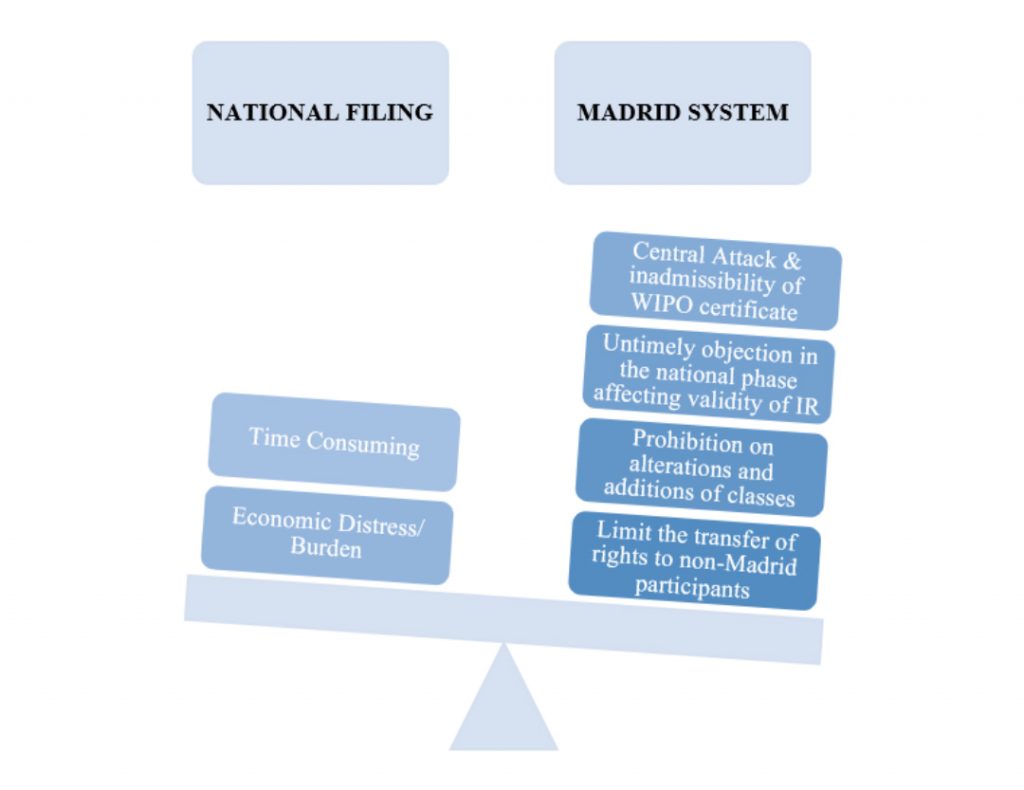
Scale of disadvantages

Fig.2: Scale of disadvantages

Although it may be appealing to blindly resort to the Madrid Protocol as it offers to be a ‘one-stop-shop’ for one’s effort to trademark coupled with the benefit of a simple yet speedy examination (as acclaimed) and a cost-effective approach by delineating the need of a local council, it is imperative to take into consideration the limitations mentioned above. Hence, it is highly advisable to conduct a cost-benefit analysis of the number of jurisdictions along with the practices opted therein since all jurisdictions are not tenable to the Protocol. Also, comprehensive searches in designated jurisdictions need to be conducted to uncover prior marks, which otherwise could prove harmful in the aftermath. A concrete branding strategy ought to be put in place to avail of the maximum potential value of the trademark at hand. 👉   For view source:  https://bit.ly/34A4B4E


Don’t forget to follow us on social media:

Facebook – https://www.facebook.com/kashishipr/

Twitter – https://twitter.com/kashishipr

Linkedin – https://www.linkedin.com/company/kashishipr/

Pinterest – https://www.pinterest.com/kashishipr/

Tumblr – https://kashishipr.tumblr.com/


Contact - US

Email Id: kashishipr@kashishipr.com

Website: www.kashishipr.com

Wednesday, 21 October 2020

Colour Trademarks in the Pharmaceutical Industry


A trademark aids the customers in identifying the goods and services of one undertaking from those of others. In the present fast-paced society, conventional marks are not the only type of marks available that are worthy of obtaining trademark protection. Colours and colour combinations play a significant role in differentiating the goods in the market. A colour trademark is the one in which there is at least one colour used that performs the function of a trademark, i.e., uniquely identifying the commercial origin of goods and services. Nowadays, several countries allow the registration of a single colour trademark. A question arises when we ponder upon the relevance of colour marks in pharmaceutical products – Is there any necessity to protect colour marks when products are bought based on prescriptions by doctors? The answer is yes. Pharmaceutical companies have increasingly started to register colour marks on pharmaceutical products to indicate the source of those products as belonging to their brand. It is because of several factors – firstly, a lot of customers nowadays purchase Over-the-Counter (OTC) drugs, and trademarks assist in recognizing a specific brand, which they trust. Secondly, a colour on pharmaceutical products has come to be seen as creating a brand image, and thirdly, colour trademarks serve as a mark of the brand, which creates it. Some examples of pharmaceutical colour trademarks are as follows:

Purple for AstraZeneca's Nexium called "The purple pill"

Purple for AstraZeneca’s Nexium called “The purple pill”

Purple for GlaxoSmithKline's Seretide Inhaler

Purple for GlaxoSmithKline’s Seretide Inhaler

SK&F's red and white Dyazide capsule

SK&F’s red and white Dyazide capsule

Understanding the Role of Colour Trademarks in the Pharmaceutical Industry

The trademarks for pharma goods can be classified into word marks, device marks, and trade dress. Word marks consist of drug names such as Nexium, Prilosec, Zinetac, etc. Device marks consist of the appearance colour, shape, and logo of the product. Trade Dress comprises packaging of drugs like containers, blisters, flasks, vials, etc.

Until the mid-1900s, all the prescription drugs that were in pill form were uniformly white and round. The OTC medication was also white or pastel in colour. Colours were introduced in the 1960s. By 1975, with the emergence of soft gel capsules, colours such as red, yellow, and lime green were seen. Today there are thousands of colours present in the pharmaceutical market. The colours chosen are for marketing purposes and have no bearing on the efficacy of the drug. Colour marks in the pharma sector have become a crucial branding technique because they address the visual features by distinguishing the products from those of the competitors. Colours are now being used for creating brand images, signifying the personality of the products, and differentiating them from other brands; due to which, the pharmaceutical companies spend large amounts of money today on the most attractive and appealing trade dress and marks for every new product brought to the market.

Colour trademarks can be useful for pharmaceutical products to remain in the market for an extended duration. The same becomes more vital when a brand’s immunity from generics comes close to an end towards the expiration of the patent term. The effectively registered trademarks with acquired distinctiveness may stop the generic companies from manufacturing identical-looking products. The customers may adhere to the registered products as the generic versions will look, unlike the original ones that belong to a brand that they already trust. In this manner, customer loyalty for branded medicines can be built for sustained trade in the marketplace and to uphold the market share even with stiff competition. Colour and colour combinations are a powerful way to create an emotional appeal.

The U.S.-based pharmaceutical company, AstraZeneca, in 2015 had filed a case before a Delaware court against the purple colour of the generic form of AstraZeneca’s antacid medicine, Nexium, which they marketed as “the purple pill.” The generic pill, also purple (in colour), was sold by Dr. Reddy’s Laboratories in the United States. AstraZeneca contended that this was a substantial breach of an agreement between the two companies. AstraZeneca argued that the shade of purple used was parallel to the shade of the original medicine – successfully infringing on its trademark registration for the purple medicines. Ultimately, Dr. Reddy’s Laboratories had to relaunch the generic capsules in blue colour.

Advantages of Colour Trademarks for Pharmaceutical Products

Trademarks

International Requirements of Registering a Colour Mark

The TRIPS Agreement lays down “Combinations of colours…shall be eligible for registration as trademarks although members may make registrability depend on distinctiveness acquired through use and members may require, as a condition of registration, that signs be visually perceptible.” Hence, countries can choose to register colour trademarks based on acquired distinctiveness and graphical representation.

In the United States, traditionally, courts were unwilling to recognize marks comprised exclusively of colours or colour combinations. It was only in 1995 that the United States Supreme Court held in the case of Qualitex Co. v. Jacobson that, “sometimes, a colour will meet ordinary legal trademark requirements. And, when it does so, no special rule prevents colour alone from serving as a trademark. However, the Court also observed that a single colour may not be intrinsically distinctive and may only be protected when it has developed a secondary meaning through use parallel to descriptive marks or words.

Countries such as Germany, Norway, Sweden, and the UK, need “display of secondary meaning or acquired distinctiveness before registering a colour per se.” The European Union Intellectual Property Office (EUIPO) also follows this rule. The UK has also acknowledged and registered colours as trademarks, for instance – “silver for anthracite briquettes,” red for the “pin of a shackle,” and “three red bands on the handle of rackets.”

The two most crucial requirements to remember for obtaining a trademark registration for a single colour mark are as follows:

Trademarks

Proprietors should be careful not to advertise or rely on colour as a necessary function of that particular product, as this would lead to rejection based on it being an essential feature of the trademark.

The Indian Perspective

In India, the pharmaceutical industry notably accounts for the maximum trademark registration applications among all the sectors. Colour marks are not easy to register in India, specifically single colour marks. Although the Trademark Act, 1999 does not explicitly forbid the registration of the single colour marks; showing distinctiveness in a single colour is tricky unless the colour, due to a long association with a specific mark, has come to characterize the source/origin of the product, enabling easy differentiation of the product from others in the same class. Nevertheless, single colour trademarks have been protected in India, such as the colour purple for Cadbury, colour blue for Parachute bottles, colour magenta for Telekom AG, and so on.

In India, OTC medicines and pharmaceutical wellness products are readily available without any requirement of a prescription. In OTC and wellness medicines, where the person makes his own buying choice is where trademarks play a much more significant role. A branded mark, which the customer is familiar with and trusts, has a higher possibility of being picked and helping build upon brand loyalty.

In Glaxo Group Limited vs. S.D. Garg case, the Court applied the principle of ‘likelihood of confusion’ based on the deceptive similarity of ‘Bectodine – M and ‘Betadine’ marks, trade dress, and packaging as well as the identity of colour scheme, get-up, and layout. The Court also observed that although medicines are used to treat the same ailment, this, however, does not negate the possibility of side effects.

The Manual of Trademarks, Practice, and Procedure 2015 provides the following points for registration of colour marks:

  • If the applicant is claiming a combination of colours, as applied to the goods or their packaging, or as used in relation to their services, as a trademark, they should claim this by identifying the trademark as a colour trademark. Along with the exact description of the colour combination as per the International Classification System of Colours as well as supplying a graphical representation of the trademark, the applicant must also provide a concise and accurate description of the trademark on the application. The manual further gives an example of a suitable form of description for a trademark, which consists of a combination of colours applied to a pharmaceutical capsule as: “The trademark consists of a maroon colour applied to one half of a capsule at one end, and a gold colour applied to the other half, as illustrated in the representation on the application.”
  • If a statement has been made in the application that the trademark consists of combination of colours only, the trademark will be regarded as colour trademark. If a particular combination of colours of packaging has become distinctive, in fact, as indicating the goods of a particular trader, there is no reason why it should not be protected by registration. However, if the colours are used not in a special or particular pattern or arrangement, it is likely to be more difficult to prove that in such cases colour would lend distinctiveness as a badge of origin.
  • Wherever the exclusive right to colour is sought, weighty evidence should be necessary to overcome the objection under Section 9(1)(a) of the Trademark Act, 1999, which bars registration of trademarks that do not have a distinctive character.
  • Single Colour: A single colour may be registerable as a trademark if it is very unusual and peculiar in a trade and is recognized by traders and consumers alike that it serves as a badge of origin for that class of goods.
  • Combination of Colours: A combination of colours may be registrable, but this will depend on its uniqueness and how it is used. If the colours are presented as a figurative mark, then as few as two colours could be accepted; when applications consist merely of colours applied to the goods or their packaging, it will be necessary to consider how unusual the colour combination is in relation to the goods and whether, prima facie, the combination is likely to strike the relevant consumer as an indication of trade source.

Final Thoughts

As colour marks are being increasingly used by the pharmaceutical industry, one needs to comply with the trademark laws and procedures and ensure that the colour mark indicates the source of the product, that the colour is not a functional aspect of the product, and that it has acquired distinctiveness. Since a single colour lacks the inherent capability to be distinct, the standard of proof has been kept high. However, there is no exhaustive test as to whether the colour has acquired distinctiveness, and it all depends upon how the customers perceive the colour. Therefore, pharmaceutical companies need to build their brand by using distinctive trademarks, specifically colour marks. The best practices to be followed in this aspect are as follows:

  • Advertisements showing that the colour has some functional advantages should be avoided.
  • The colour feature should be used in a very specific manner on specific products such that it leaves many available alternative branding features for those manufacturing the same drug. For example, with Nexium, there was no advantage of making the pill purple other than making it identifiable to the brand. It left numerous other types of features and colours available to those manufacturing the same antacid pill.
  • The colour feature of the drug should be marketed well.
  • In case of a single colour mark, it should be registered once it has acquired distinctiveness, hence adding valuable protection to a pharmaceutical brand.
  • The particular colour(s) on which protection is being sought should be defined well with the help of internationally recognized colour identification systems such as the Pantone Matching System. 👉 ✅  For view source:  https://bit.ly/2FQe3r0

Thursday, 6 February 2020

Operative Strategy to Protect Your Intellectual Property in India


Intellectual Property in India

Are you among people who own businesses exporting to or operating in India or who are considering it as a future market? Note that your Intellectual Property (IP) is a valuable business asset, and in an emerging market such as India could be your main competitive advantage. Hence, you should have an IP management strategy that identifies all of your IP to protect them and extract profit from them.
India has been operating as a member of the World Trade Organization (WTO) since 1995. Therefore, it is common to find similarities between the IP Law of India and that is in force in the UK. India is also a signatory to several international treaties on Intellectual Property Rights (IPRs) like trademarks, patents, and Industrial Designs, which can be protected through registration. Enforcement procedures of these rights are taken care of by the Indian courts that can provide interim remedies like injunctions in the event of an infringement. The courts can even instruct perpetrators to accounts for monetary or other profits generated from infringement.

Registering IPRs in India
Intellectual Property Protection is jurisdiction-specific. It means the registration of IP in India is essentially required even if they are already protected in the UK. Considering backlogs at the IP registries, registration of trademarks, copyrights, patents, and others could take months or years. So the businesses should plan to register their IP prior to entering the market. Indeed, even the experienced IP Attorneys suggest that the owners should register their IP as soon as they could.

IP Enforcement in India
In India, there are three IP enforcement channels, including police, customs, and judiciary. Patents and designs can be enforced through civil litigation, whereas trademarks and copyrights can be enforced through any of the criminal or civil litigation. Some remarkable risks with IP enforcement in India are as follows:
  • Systematic and capacity associated issues, compounded by lack of awareness regarding IP protection amongst the public
  • Judicial delays, where Indian courts can take months or even years to come to a final verdict. However, they can grant interim injunctions that offer immediate relief to the rights-holders pending the consequences of cases against infringers
  • Small players account for several IP infringements. It means that breakdowns, even if small, require sustained and costly efforts to make any vital impact.
A noticeable advantage for the foreign businesses running in India is that the legal system is based on law common to several nations, so the fundamental processes are quite similar.

Checklist for an Operative IP Strategy in India
India is one of the continuously emerging markets that can help new players and already established businesses to make considerable profits, which can then add to their growth and success. Some of the steps you should consider to build an IP strategy that can ensure your growth, along with keeping the IP issues away, are:

Be Meticulous as Prevention is Better than Cure
The foremost thing you should do is to be aware of as much information as possible. Find out local risk reviews, seek advice from IP experts, and go through websites rendering information on IP related subjects. Conduct proper risk assessments and due diligence on individuals, organizations, or any third-party that you will be dealing with either for licensing your IP or anything else. It will provide you with an idea on how to protect your genuine products from being infringed, i.e., copied or sold under a different name or by an unauthorized user.

Secure Your IP Rights
Under the assistance of an experienced IP Lawyer, register your IPRs in India. Since registration could take time, you should plan for the same well ahead of entering the market. Stay careful during the entire process from application to grant of the registration certificate.

Don’t Miss the Dispute Resolution Clauses
Besides including appropriate dispute resolution clauses in legal contracts, you should also consider mediation before defensive action. Reduce risks of infringement by ensuring that your contract is watertight in relation to your IP Rights. Nevertheless, if you still face piracy or violation, then it is better to appoint a skilled attorney who can understand your concern and initiate appropriate legal proceedings.

Build Good Relationships with Helpful Organizations
There are many organizations and individuals that can help you with subjects related to your IP. For instance, suggestions can be acquired from organizations like the UK India Business Council, the UK IPO, and Chambers of Commerce. You may also consult with agents, suppliers, and distributors who conduct similar businesses in India on how to safeguard your IP rights in this nation.

Believe in Constant Innovation
In the emerging economies where a large number of players account for several infringements, constant innovation often acts as a key to protect your competitive advantage. While IP protection boosts innovation, constant innovation provides an added protection against infringers.  
✅  For more visit: https://www.kashishipr.com/ 

Don’t forget to follow us on social media:


Contact - US

Tuesday, 4 February 2020

Goa’s Khola Chilli Gets Geographical Indication Tag


Geographical Indication Registration

There is fabulous news for not just the Goans but all Indians as well. The famous Khola Chilli or Kholchi Mirchi that’s being grown on the hills of Khola village in Canacona taluka region of Goa has received the Geographical Indication tag from the Geographical Indications Registry.
The prestigious GI certificate for this Chilli variety has come to give exclusive brand protection rights to the farmers of Canacona who has been growing this horticultural spice crop for ages. This award has thrown up remarkable opportunities to the cultivators as well as authorities to take the Canacona Chilli to the worldwide market.
It is believed that most of the Chillies varieties grown in Goa today were introduced by the Portuguese. However, over the centuries, various hybrid varieties have emerged from what’s brought from overseas.
Science and Technology Minister Michael Lobo announced that the Khola Chilli is the first agriculture produce of the state to get the GI tag. The state government now plans to receive the GI tag for other items like Goa’s coconut vinegar, Harmal Chillies, Maindoli banana, Bebinca, Mancurad mango, Cashew nuts, Brinjal, local rice varieties, etc.
The unique Khola Chillies are grown on the hill slopes under rainfed conditions only. Local soil and climate play a crucial role in maintaining the quality of this Chilli variety, which is known for its brilliant red color and medium-pungent taste.
Lobo rued the lack of interest in farming and agriculture among youth and said that elders in the state are actively engaged in farming, but youth don’t want to take it up. Revealing his and state government’s objective to make more youngsters in Goa take up farming, he said that getting a GI tag will help the cultivators not just promote and sell their products but also export them, thus making farming profitable and developing youth’s interest in farming. Moreover, this could help Goa improve its agricultural yield and decrease its dependence on other regions (states) for food. That is the reason why the government has taken this step, said the minister.
Shivram Naik Gaonkar – ZA Officer – said that the GI tag could help the Canacona Chilli to become world-famous, and thus, the demand would increase substantially. The farmers, on their part, need to increase this crop’s production to enhance their income. Earlier, the crop was famous only in Goa, but now after getting the Geographical Indication Protection, it will receive worldwide recognition. All these facts will increase the market for this indigenous crop. That’s why they are serious about certifying this spice as organic so that the farmers get a premium rate, said Naik Gaonkar.
Most farmers growing this chilly are thankful to the Agricultural Department, ICAR, and Department of Science and Technology, Goa for putting Khola/ Canacona chilly and their village on all India map, and expected more support in the form of the Geographical Indication Registration for other products, which are equally indigenous and unique to the region. For more visit: https://www.kashishipr.com/ 
Don’t forget to follow us on social media:


Contact - US

Thursday, 7 November 2019

Delhi HC: Applicants Own Right to Know Reason for Trademark Application Rejection


Trademark Application

The Delhi High Court (HC) recently has held that the trademark registrar is duty-bound to provide the applicant with the replica of an order passed under Section 18(5) of the Trademarks Act, 1999 comprising the ground for refusal/conditional acceptance in addition to the materials he used to reach the decision.
The Court has stated that Rule 36 of the Trademarks Rules, 2017 is unreasonable, arbitrary, and inconsistent with the Act insofar because it empowers the Registry to express the decision without including the grounds for refusal/conditional acceptance.
The ruling was passed by a Single-judge Bench of Justice JR Midha following a petition favored by the Intellectual Property Attorneys Association. The association had moved to the Court after being wronged by non-speaking orders passed by the registrar of trademarks while refusing applications for Trademark Registration.
It was asserted that such refusals were violating Section 18(5) of the Trademarks Act. Besides, it was argued that the terms mandated the registrar to maintain written records of the grounds for refusal or conditional acceptance along with the materials he used to arrive at his decision.
On the other side, Rule 36 of Trademarks Rules, 2017, states that the registrar shall provide the decision in writing to the applicant. Moreover, if the applicant wants to file an appeal for getting the grounds behind the decision, he might do so within 30 days in Form TM-M.
Hence, the association concluded and argued that as far as the supply of reasons behind the refusal was concerned, Rule 36 was in contravention of Section 18(5).
To finish after hearing the parties, the Court approved the petition made by the Intellectual Property Attorneys Association. It held that the trademarks registrar/administrator was duty-bound to provide the applicants (who file Trademark Applications) with the copy of the order passed under Section 18(5) to make them familiar with the reasons for refusal or conditional acceptance and the materials he deployed to come up with that decision.
The Court further clearly held that Rule 36 was arbitrary, unreasonable, and inconsistent with the Act. It agreed with the association and ordered that the petition is approved. It added that the registrar of the trademarks is directed to stringently implement Section 18(5) of the Trademarks Act by maintaining written records of grounds for refusal/conditional acceptance and also sending the same to the applicant within fourteen days of the passing of the order. ✅ For view-source: https://bit.ly/2ClGvLV

Don’t forget to follow us on social media:


Blockchain: An Advanced Way to Protect, Manage, and Monetize Your IP


Intellectual Property

Are you facing issues in protecting, managing, or monetizing your Intellectual Property (IP)? Don’t worry, as you can now implement blockchain technology, which works as an advanced tool to help you protect, manage, and monetize your IP.
Intellectual property, which refers to outcomes of the human mind, includes many different things. From inventions to artistic works and unique products, almost every uncommon and useful thing can rest under its umbrella. Whether you create a symbol, write a book, design a game, or come up with any other intangible media, you (as an author) can access and enjoy Intellectual Property Rights (IPRs) over the same. Nevertheless, the present system appears a bit weak to bring this phenomenon in practice. You are possibly aware of how easy it is for others to steal your content nowadays when the internet facilitates your data to flow freely across the globe.
Blockchain technology provides an incorruptible digital ledger that aids you in tracking assets and recording transactions in a business network. Assets can be tangible such as cash, cars, and houses or intangible like IP. Working as a tool to store and manage assets on a decentralized ledger and track transactions associated with digital content, including anything – music to pieces of art, etc., blockchain ensures reliability, accountability, and transparency. In this way, it allows an immediate revenue stream for creators by enabling a direct relationship between them and consumers.

IP Protection with Blockchain

As a creator of content, image, or anything else, you can understand how frustrating it is to put in efforts and time on something that people can access freely without your consent and any compensation. Moreover, you also comprehend the importance of retaining ownership rights as it is the easiest method to avoid such frustrating acts. Nevertheless, with the current model of the IP industry where getting your asset registered is a time taking process and the internet that has made copying content quite easy, doing so appears a bit hard. Worst, proving infringement of your content in court without proof of ownership becomes difficult. Here, blockchain digital ledgers that emphasize working with time-stamped and unalterable records come up as the perfect place to store evidence of your ownership rights. They provide a solution for authenticating and proving the time of creation and the identity of the original creator, thus eliminating all sorts of doubts and making it easier for creators to enforce their rights when Copyright Infringement of their content occurs.

IP Management with Blockchain

In the present era, once creators upload their work online, it becomes arduous for them to maintain control of the same. Moreover, not only the creators find it problematic to know who is using or making profits from their content, but even third-parties who wish to seek a license to use someone’s IP face difficulty in determining the relevant owner. All these facts result in increasing infringement issues and preventing authors from properly monetizing their works. The blockchain technology, which maintains a fair digital record enough to prove the creator’s authenticity, can prevent the occurrence of such issues. Besides, by maintaining transparency, it helps third parties to identify the original owner and get his/her permission to use the content. And this, ultimately, benefits the creators with the option to obtain expected compensation in exchange for licensing their IP.

IP Monetization with Blockchain

Blockchain technology-based smart contracts play an active role in helping creators monetize their IP. These contracts empower creators to not only dictate the fee and terms of their licensing agreements and ensure that the licensee is using it as expected but also license content directly to end-users. They can also serve you with benefits like automatic payment triggering whenever people access your content, appropriate scaling of compensations, etc. Blockchain, in this manner, aids you to save your money and monetize IP effectively as with smart contracts, you needn’t have middlemen.

Conclusion

Almost every one of us knows that blockchain technology, if used correctly, can help creators in improving efficiency, cutting expenses, and increasing revenue by creating new products. Still, many individuals and enterprises often ignore stepping ahead with it. Well, whether to use blockchain for protection, management, and monetization of your IP or not is your choice. Nonetheless, if you want to experience noteworthy protection of your IP and suitable compensation for your creative works, it is advisable to go for this advanced technology.   For view-source: https://bit.ly/32nrwvG
Don’t forget to follow us on social media: