Showing posts with label intellectual property right protection. Show all posts

Wednesday, 21 October 2020

Colour Trademarks in the Pharmaceutical Industry


A trademark aids the customers in identifying the goods and services of one undertaking from those of others. In the present fast-paced society, conventional marks are not the only type of marks available that are worthy of obtaining trademark protection. Colours and colour combinations play a significant role in differentiating the goods in the market. A colour trademark is the one in which there is at least one colour used that performs the function of a trademark, i.e., uniquely identifying the commercial origin of goods and services. Nowadays, several countries allow the registration of a single colour trademark. A question arises when we ponder upon the relevance of colour marks in pharmaceutical products – Is there any necessity to protect colour marks when products are bought based on prescriptions by doctors? The answer is yes. Pharmaceutical companies have increasingly started to register colour marks on pharmaceutical products to indicate the source of those products as belonging to their brand. It is because of several factors – firstly, a lot of customers nowadays purchase Over-the-Counter (OTC) drugs, and trademarks assist in recognizing a specific brand, which they trust. Secondly, a colour on pharmaceutical products has come to be seen as creating a brand image, and thirdly, colour trademarks serve as a mark of the brand, which creates it. Some examples of pharmaceutical colour trademarks are as follows:

Purple for AstraZeneca's Nexium called "The purple pill"

Purple for AstraZeneca’s Nexium called “The purple pill”
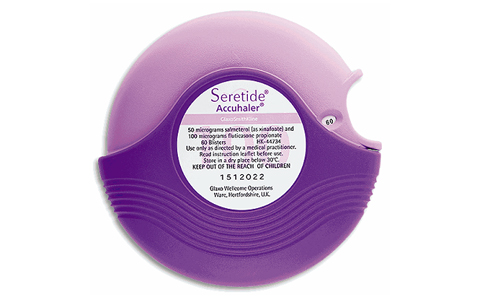
Purple for GlaxoSmithKline's Seretide Inhaler

Purple for GlaxoSmithKline’s Seretide Inhaler
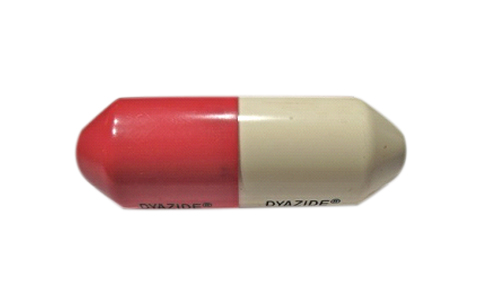
SK&F's red and white Dyazide capsule

SK&F’s red and white Dyazide capsule

Understanding the Role of Colour Trademarks in the Pharmaceutical Industry

The trademarks for pharma goods can be classified into word marks, device marks, and trade dress. Word marks consist of drug names such as Nexium, Prilosec, Zinetac, etc. Device marks consist of the appearance colour, shape, and logo of the product. Trade Dress comprises packaging of drugs like containers, blisters, flasks, vials, etc.

Until the mid-1900s, all the prescription drugs that were in pill form were uniformly white and round. The OTC medication was also white or pastel in colour. Colours were introduced in the 1960s. By 1975, with the emergence of soft gel capsules, colours such as red, yellow, and lime green were seen. Today there are thousands of colours present in the pharmaceutical market. The colours chosen are for marketing purposes and have no bearing on the efficacy of the drug. Colour marks in the pharma sector have become a crucial branding technique because they address the visual features by distinguishing the products from those of the competitors. Colours are now being used for creating brand images, signifying the personality of the products, and differentiating them from other brands; due to which, the pharmaceutical companies spend large amounts of money today on the most attractive and appealing trade dress and marks for every new product brought to the market.

Colour trademarks can be useful for pharmaceutical products to remain in the market for an extended duration. The same becomes more vital when a brand’s immunity from generics comes close to an end towards the expiration of the patent term. The effectively registered trademarks with acquired distinctiveness may stop the generic companies from manufacturing identical-looking products. The customers may adhere to the registered products as the generic versions will look, unlike the original ones that belong to a brand that they already trust. In this manner, customer loyalty for branded medicines can be built for sustained trade in the marketplace and to uphold the market share even with stiff competition. Colour and colour combinations are a powerful way to create an emotional appeal.

The U.S.-based pharmaceutical company, AstraZeneca, in 2015 had filed a case before a Delaware court against the purple colour of the generic form of AstraZeneca’s antacid medicine, Nexium, which they marketed as “the purple pill.” The generic pill, also purple (in colour), was sold by Dr. Reddy’s Laboratories in the United States. AstraZeneca contended that this was a substantial breach of an agreement between the two companies. AstraZeneca argued that the shade of purple used was parallel to the shade of the original medicine – successfully infringing on its trademark registration for the purple medicines. Ultimately, Dr. Reddy’s Laboratories had to relaunch the generic capsules in blue colour.

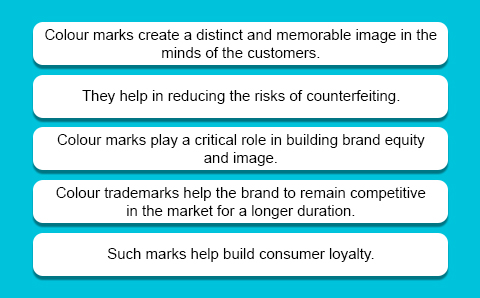
Advantages of Colour Trademarks for Pharmaceutical Products
Trademarks

International Requirements of Registering a Colour Mark

The TRIPS Agreement lays down “Combinations of colours…shall be eligible for registration as trademarks although members may make registrability depend on distinctiveness acquired through use and members may require, as a condition of registration, that signs be visually perceptible.” Hence, countries can choose to register colour trademarks based on acquired distinctiveness and graphical representation.

In the United States, traditionally, courts were unwilling to recognize marks comprised exclusively of colours or colour combinations. It was only in 1995 that the United States Supreme Court held in the case of Qualitex Co. v. Jacobson that, “sometimes, a colour will meet ordinary legal trademark requirements. And, when it does so, no special rule prevents colour alone from serving as a trademark. However, the Court also observed that a single colour may not be intrinsically distinctive and may only be protected when it has developed a secondary meaning through use parallel to descriptive marks or words.

Countries such as Germany, Norway, Sweden, and the UK, need “display of secondary meaning or acquired distinctiveness before registering a colour per se.” The European Union Intellectual Property Office (EUIPO) also follows this rule. The UK has also acknowledged and registered colours as trademarks, for instance – “silver for anthracite briquettes,” red for the “pin of a shackle,” and “three red bands on the handle of rackets.”

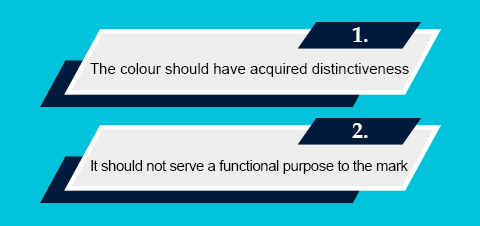
The two most crucial requirements to remember for obtaining a trademark registration for a single colour mark are as follows:
Trademarks

Proprietors should be careful not to advertise or rely on colour as a necessary function of that particular product, as this would lead to rejection based on it being an essential feature of the trademark.

The Indian Perspective

In India, the pharmaceutical industry notably accounts for the maximum trademark registration applications among all the sectors. Colour marks are not easy to register in India, specifically single colour marks. Although the Trademark Act, 1999 does not explicitly forbid the registration of the single colour marks; showing distinctiveness in a single colour is tricky unless the colour, due to a long association with a specific mark, has come to characterize the source/origin of the product, enabling easy differentiation of the product from others in the same class. Nevertheless, single colour trademarks have been protected in India, such as the colour purple for Cadbury, colour blue for Parachute bottles, colour magenta for Telekom AG, and so on.

In India, OTC medicines and pharmaceutical wellness products are readily available without any requirement of a prescription. In OTC and wellness medicines, where the person makes his own buying choice is where trademarks play a much more significant role. A branded mark, which the customer is familiar with and trusts, has a higher possibility of being picked and helping build upon brand loyalty.

In Glaxo Group Limited vs. S.D. Garg case, the Court applied the principle of ‘likelihood of confusion’ based on the deceptive similarity of ‘Bectodine – M and ‘Betadine’ marks, trade dress, and packaging as well as the identity of colour scheme, get-up, and layout. The Court also observed that although medicines are used to treat the same ailment, this, however, does not negate the possibility of side effects.

The Manual of Trademarks, Practice, and Procedure 2015 provides the following points for registration of colour marks:

  • If the applicant is claiming a combination of colours, as applied to the goods or their packaging, or as used in relation to their services, as a trademark, they should claim this by identifying the trademark as a colour trademark. Along with the exact description of the colour combination as per the International Classification System of Colours as well as supplying a graphical representation of the trademark, the applicant must also provide a concise and accurate description of the trademark on the application. The manual further gives an example of a suitable form of description for a trademark, which consists of a combination of colours applied to a pharmaceutical capsule as: “The trademark consists of a maroon colour applied to one half of a capsule at one end, and a gold colour applied to the other half, as illustrated in the representation on the application.”
  • If a statement has been made in the application that the trademark consists of combination of colours only, the trademark will be regarded as colour trademark. If a particular combination of colours of packaging has become distinctive, in fact, as indicating the goods of a particular trader, there is no reason why it should not be protected by registration. However, if the colours are used not in a special or particular pattern or arrangement, it is likely to be more difficult to prove that in such cases colour would lend distinctiveness as a badge of origin.
  • Wherever the exclusive right to colour is sought, weighty evidence should be necessary to overcome the objection under Section 9(1)(a) of the Trademark Act, 1999, which bars registration of trademarks that do not have a distinctive character.
  • Single Colour: A single colour may be registerable as a trademark if it is very unusual and peculiar in a trade and is recognized by traders and consumers alike that it serves as a badge of origin for that class of goods.
  • Combination of Colours: A combination of colours may be registrable, but this will depend on its uniqueness and how it is used. If the colours are presented as a figurative mark, then as few as two colours could be accepted; when applications consist merely of colours applied to the goods or their packaging, it will be necessary to consider how unusual the colour combination is in relation to the goods and whether, prima facie, the combination is likely to strike the relevant consumer as an indication of trade source.

Final Thoughts

As colour marks are being increasingly used by the pharmaceutical industry, one needs to comply with the trademark laws and procedures and ensure that the colour mark indicates the source of the product, that the colour is not a functional aspect of the product, and that it has acquired distinctiveness. Since a single colour lacks the inherent capability to be distinct, the standard of proof has been kept high. However, there is no exhaustive test as to whether the colour has acquired distinctiveness, and it all depends upon how the customers perceive the colour. Therefore, pharmaceutical companies need to build their brand by using distinctive trademarks, specifically colour marks. The best practices to be followed in this aspect are as follows:

  • Advertisements showing that the colour has some functional advantages should be avoided.
  • The colour feature should be used in a very specific manner on specific products such that it leaves many available alternative branding features for those manufacturing the same drug. For example, with Nexium, there was no advantage of making the pill purple other than making it identifiable to the brand. It left numerous other types of features and colours available to those manufacturing the same antacid pill.
  • The colour feature of the drug should be marketed well.
  • In case of a single colour mark, it should be registered once it has acquired distinctiveness, hence adding valuable protection to a pharmaceutical brand.
  • The particular colour(s) on which protection is being sought should be defined well with the help of internationally recognized colour identification systems such as the Pantone Matching System. 👉 ✅  For view source:  https://bit.ly/2FQe3r0

Tuesday, 17 March 2020

Local IT Company Sues Microsoft Alleging Trademark Infringement


Trademark Infringement

Azure Knowledge Corporation, an Ahmedabad-based Information Technology (IT) company, has quite recently filed a lawsuit in the city civil court against the tech giant Microsoft Corporation and its Indian arm, Microsoft India, alleging Trademark Infringement. DV Shah, the judge for the lawsuit filed, had issued notices to the defendants on 10th February 2020 itself, and will now take up the matter on 18th April 2020. Furthermore, Azure has also moved a petition in the Intellectual Property Appellate Board (IPAB) corresponding to seeking cancellation of the Trademark Registration of the term “Windows Azure” that is used by Microsoft for its offerings.
In its lawsuit filed, Azure has stated that since 1996, it has been using the term “Azure” as a trade name and trademark, that too, for a variety of businesses. Moreover, the company has also registered the mark Azure under various trademark classes. It had got its label mark and wordmark registered in 1998 with the user date from 1996. Software major, Microsoft, on the other hand, had launched and introduced the mark “Azure” for the very first time in India only in 2014, and since then, the company has been selling its Cloud Services Platform under the same name.
Azure is now looking forward to seeking the court’s decision corresponding to not allowing Microsoft to force a locally grown company to surrender its statutory and legal rights. Azure stated that it has indeed spent a substantial amount of time in promoting and marketing the Azure mark along with its logo over the years. The trademark infringement lawsuit filed by Azure also seeks the court’s decision corresponding to restraining Microsoft from using the mark Azure, Azure Cosmos DB, Microsoft Azure, Azure Brain Wave, Azure Sphere, Azure Cloud For All, and other related names. Additionally, the local IT Company wants the court to stop Microsoft from using the domain name “azure.microsoft.com.” It also wants an account of the profits earned by Microsoft from the illegal use of the trademark “Azure.” For more visit: https://www.kashishipr.com/ 

Don’t forget to follow us on social media:


Contact - US

Monday, 2 March 2020

What is a Trademark?


 trademark registration

With realms of experience in all areas of IP law and a team of professional lawyers focusing exclusively on trademark-related matters, KashishIPR delivers solutions that meet the ever-growing needs of the clients. ✅   For more visit: https://www.kashishipr.com/

Don’t forget to follow us on social media:


Contact - US

Tuesday, 7 January 2020

Japan Seeks to Reinforce Intellectual Property for Fruits and Veggies


intellectual property protection

With the advent of the year 2020, there comes news that Japan is planning to strengthen Intellectual Property (IP) control over its premium products, like fruits and vegetables being sold overseas to prevent its high-end crops from being grown and then sold as the products of other countries.
As per Japan’s Ministry of Agriculture, Forestry, and Fisheries (MAFF), the crops that have been influenced by the failure to appropriate implementation of IP control abroad include the high-end Shine Muscat grapes. It is a crop being produced by other nations such as Korea and China.
FoodNavigator-Asia, one of the leading online news sources for the food industry for near about 20 years, confirmed with MAFF that the proposed initiative for ministry to handle this situation is to appoint a private company to work on the Intellectual Property Protection of Japan’s newly cultivated fruits and vegetables.
MAFF officer, who opted to remain anonymous, emphasized that although it hasn’t yet been confirmed, the department is seeking at budgeting for such a company to help Japan secure new fruit and vegetable varieties. He added that discussion on this matter is on-going internally, but no official details are in place till now. This protection would likely be applied only to new produce varieties.
That said, if approved, such a move would bring good outcomes for the country’s agricultural industry, which is striving to boost up its high-end fruit and vegetable exports from the current estimated JPY1tn (US$9.2mn), as per Japan times.
Japan’s Ministry of Agriculture, Forestry, and Fisheries’s Intellectual Property Strategy 2020 report also lined up strengthening the IP protection of new plant varieties as a vital area of focus to uplift competitiveness of the nation’s seed and seedling industry.
MAFF, in the strategy report, said that it is crucial to establish an environment where breeders can easily obtain and use legal rights to promote the new and excellent plant varieties with international competitiveness both in Japan and abroad. Measures to strengthen IP protection was highlighted as a significant section of the report, with the ministry aiming to do so by both:
·         Providing support against any IP infringement
·         Developing technology and tools that can aid the IP-holders to prove their rights to ownership
MAFF added that it is essential to ensure that the right holders can confirm the IP violation overseas and take border measures promptly and appropriately. Besides these, several other efforts are being planned by Japan and MAFF. One out of them includes methods to identify the geographical area where a product is being produced and ways to conserve varieties for which new applications have been filed.
As part of the doings undertaken by MAFF Intellectual Property Consortium, which is known as Japan’s IP protection watchdog for its products’ overseas Trademark Applications, activities related to Geographical Indication ranked very high on the list, according to the consortium’s latest report.
Emphasizing GI, MAFF said that in Japan, many brand products have already obtained a remarkable reputation because of their unique production approaches and natural characteristics like regional climate and soil conditions. The GI Act helps the government to protect the name of such products.
He ended by saying that Japan works with a dedicated GI symbol to indicate protected products. Moreover, to achieve its aim, the nation has recently established a webpage on the online tax donation website Satofull. It is a site that allows people to donate their produces to preferred municipalities in situations of disaster. In return, they would be benefitted by having a large portion of total donation deducted from their taxes. For more visit: https://www.kashishipr.com/ 

Don’t forget to follow us on social media:


Contact - US

Tuesday, 17 December 2019

CII Industrial Intellectual Property Awards 2019: 11 Companies Emerged Winners


intellectual property right protection

On December 4, CII Industrial Intellectual Property Awards 2019 were conferred on 11 companies for the best portfolios in Trademarks, Designs, and Patents. The awards were given at the Fifth International Intellectual Property Right (IPR) Conference, organized jointly by CII (Confederation of Indian Industry), Intellectual Property Office India, and the Department for Promotion of Industry and Internal Trade (DPDT). The theme of this conference was innovation and IP-led technology for a $5 Trillion Economy.
Recognized and awarded enterprises that have embraced Intellectual Property (IP) generation and protection to enhance their business and economic growth, the purpose of these awards is to:
·         Bring achievements of companies in the public domain,
·         Encourage firms to reinforce the culture of IP and its commercialization,
·         Set up links with research institutions and academic in India and abroad,
·         Inform the government about IP-driven companies and engage them in policy-making exercises.
Each award included a trophy and a certificate. Moreover, the selection of awardees was made by an eminent jury chaired by the former Director-General of CSIR (Council of Scientific and Industrial Research), Dr.Raghunath Anant Mashelkar.
Dr.Mashelkar, while speaking at the award ceremony, stressed upon the requirement to bring as more as possible companies within the framework of this exercise so that there would be a remarkable awareness of the profits of creating and using IP. He said that just creating IP is not sufficient, and thus, there is a need to explore its commercialization as well. The creation of IP in the form of new products or services without any tangible benefits is not of much use, he added.
Winners of 2019’s CII Industrial IP Awards include companies like Tata Consultancy Services (TCS), Godrej & Boyce, and others that are at the forefront of IP creation and commercialization.
Under the Start-ups category, there were five awards – three in life science and two in engineering. SigTuple, this time winner of the best patents portfolio award under the start-ups engineering group, had won this award in 2018 also. However, City Explorers – the achiever of the best trademark award under this category had made its debut in 2019. Similarly, Shashvi Remedies that fall in the life science category had won the award for the first time. Prantae Solutions had won both trademark and design awards under the Start-ups life science category. It was a winner in 2018 also.
In the small enterprise category, the jury awarded only one company in life science – Chemical Resources – for its patents portfolio. The company had won the award for the first time. Among small enterprises, no one was selected for trademark and design award, neither in life science and nor in engineering.
Among the medium enterprises, one award each in engineering and life science was awarded. RDL Technologies, which received the award for its patents portfolio in engineering, was the first-time winner, whereas Vyome Therapeutics in life science had got this award in last year’s award ceremony also.
The large companies segment saw six awards going to TCS, Godrej & Boyce, UPL, and more. TCS won the best patent award for the fourth time. Godrej & Boyce won the awards for its trademark and design. UPL was awarded for its two portfolios – trademarks and patents – in the life science category. For more visit: https://www.kashishipr.com/ 

Don’t forget to follow us on social media:


Contact - US

Monday, 16 December 2019

Facebook Kills Misleading Election Ads, Cites Intellectual Property Reasons


intellectual property right protection

Over the weekend, Facebook (FB) banned a British election ad from the Conservative Party after the BBC (British Broadcasting Corporation) complained that the footage distorted its journalism.
However, it was just for business reasons that had nothing to do with freedom of speech – Intellectual property Rights.
The BBC complained that the fifteen seconds ad in question includes a video from the Conservative Party that used news clips from it and could damage the perceptions of its impartiality.
CNN business, a financial information and news website, reported that the ad in question showed clips of BBC journalists saying things such as ‘pointless delay to Brexit’ beside a montage of protest footage and discussions in parliament, set to dramatic music. But, the clips were from journalists quoting statements of politicians, including Prime Minister Boris Johnson, who is going to campaign in the December 12 election with the slogan ‘get Brexit done.’
According to Facebook’s ad library, the ad started on 28th November 2019 had been viewed around 430,000 times for a cost of about $12,930 till December 1 when it was replaced with the below message provided in the library:
“This ad was taken down as it goes against Facebook’s Intellectual Property (IP) policies.”
The BBC said that they first asked the Conservative Party to take the ad down, but the party declined. Hence, they approached FB, which banned it.
Facebook said that it was a valid IP claim from the rights holder, i.e., the BBC, as the Conservative Party had used its footage without permission.
Facebook’s spokesperson added that whenever they receive valid IP claims against any content on their platform, whether in advertisements or elsewhere, they take the required action according to their policies.
As per Facebook’s advertising policies, ads must never contain content that violates or infringes on the rights of others, including copyright, trademark, and other personal or proprietary rights.
Well, the social media giant’s policy on the election or political ads has received severe criticism worldwide. The United Kingdom (UK) imposes rules on how broadcasters can report on political biases, especially around elections. As newspapers hold the freedom to impart politics, broadcasters should be impartial. Since the BBC is publicly funded, it often faces intense scrutiny.
The analysis prompted Twitter to announce that it would limit political ads in the upcoming month.
Facebook, rather than addressing the BBC’s claim that its materials had been used misleadingly, stuck to the legal arguments.
If we talk about the Conservative Party, it did not respond to CNN’s request for comment but announced that all political parties use BBC’s content. The Party added that it would ask the BBC if they, in the interests of fairness, intend to complain against other political parties that are using their content. For more visit: https://www.kashishipr.com/ 

Don’t forget to follow us on social media:


Contact - US

Sunday, 15 December 2019

China Bids to Lead Global Organization Protecting Intellectual Property


intellectual property right protection

Beijing, the sprawling capital of China, has bid to lead the world agency that’s supposed to safeguard Intellectual Property (IP) and set international standards for trademarks, copyrights, and patents.
To indicate its desire to more effectively manage the international IP system surrounding Intellectual Property Rights (IPRs), China had already nominated a candidate to head the World Intellectual Property Organization (WIPO) in the first week of November 2019. However, considering China’s track record, including support for U.S. enemies, rampant IP theft, and corporate espionage, many trade experts are wary, to say the least. For instance – some years ago, the United States opposed even the creation of a patent office in China, claiming that the stringent safeguards for securing the confidentiality of trade secrets in Patent Applications might be at risk of intrusions in China.
James Pooley, former deputy director-general at WIPO, said that protecting trade secrets of the applicants was a crucial part of what they are doing. Moreover, the Trump administration’s perspective regarding China is that this nation is a thief. So, how could the authorities even think about making the fox in charge of the henhouse?
Reason for Beijing’s This Move
Typically, one of the several reasons why Beijing took this move is that China, in the present times, is producing a great deal of IP of its own. For several years, although China had exhibited little interest in carving out the role of a leader at WIPO, it has been deepening its formal relationship with the agency that sets the rules for worldwide copyrights, patents, and trademarks. Today, the time after more than a decade when Beijing launched its campaign to boost indigenous innovation, the nation has emerged as the main innovator of its rights and is taking a deep interest in Intellectual Property Protection.
According to some diplomatic sources, the US officials so far have talked to several countries to try to persuade Beijing (China) to reconsider its bid and accept another senior management position at WIPO rather than the top job at the agency.
The Chinese Bid
The recent bid poses a remarkable challenge for the US that has been pushing to restrain China’s growth as a technological superpower while inspecting its developing diplomatic clout at the UN and other international agencies. The potential challenge from China to the stewardship of worldwide intellectual property standards appears when Beijing is looking for rewriting the rules for larger swaths of the global economy, encompassing the role of state-owned firms, the use of state finances to obtain other geopolitical gains, etc. Some famous economists found that due to the unfair trade practices, like counterfeiting and theft of trade secrets by China, the US loses more than $50 billion a year.
As per the WIPO figures provided in October 2019, the election efforts are expected to bring positive outcomes for China as it is emerging as a leading nation in artificial intelligence (AI) and next-generation 5G mobile technologies. Besides, it is the most productive patent filer, accounted for around half of the more than 3.3 million global patents filed in the year 2018. For more visit: https://www.kashishipr.com/ 

Don’t forget to follow us on social media:


Contact - US